The next buyer might not come to your website. They might let an AI agent do the shopping for them.
Savvy AI agents will identify the best option, assess prices and reviews, determine availability, and complete the purchase.
That fundamentally transforms digital business.
Companies have optimized for customers moving through digital funnels. For more than 20 years, we have built digital businesses geared for customers to search, click, browse, compare, and ultimately convert.
Agentic commerce alters digital business. The agent discovers, evaluates, decides and transacts.
That’s a significant shift for CXOs. Agentic commerce fundamentally transforms the customer journey. For brands, it alters how they earn a place in consideration.
New demands are placed on CXOs.
- Products need to be researched by AI.
- Product data must be interpretable by AI.
- Commerce systems need to be actionable by AI.
The fundamental question isn’t whether a company is optimized for customers. The important question is whether the company is prepared for the customers’ agents. This guide explains how agentic commerce transforms various aspects of doing business.
1. Why Traditional Commerce Is Breaking Down
The architecture of digital commerce of the last 26 years has been:
Search → Browse → Compare → Add to Cart → Pay → Track Order.
While you’ve been meticulously crafting your page, hiring the best designers to ensure your UI/UX is on point, and obsessing about your checkout flow, your customers are no longer buying themselves. Instead, they are telling Muse or ChatGPT, or their smart fridge to do the shopping for them. "Buy me the best organic protein powder." AI never really saw your page. It assessed your metadata, and if it was messy, it wouldn’t even consider your page.
The traditional model of commerce relied on the user performing the research. The interface assisted in taking action. Merchants optimized funnels, but couldn’t influence the research or the users’ decision making process.
Today, these assumptions are breaking down with the 3 following pressures:
1.1 Information Overload
There are simply too many brands and too much information for the user to evaluate and make an objective choice on the best product to buy.
I don't think it would be wrong to say that information has gone beyond human evaluability.
- 100,000+ SKUs
- Dozens of competing subscription plans
- 20+ pages of "features and specs" with different price points
Customers can’t be served more information. They need to delegate.
1.2 The Death of the Traditional Funnel
Google's AI Overviews and AI Mode, TikTok's algorithmic shopping and LLM-based assistants are changing how discovery works.
This is shaping up to be the age of discovery, of not taking the traditional path from search -> product detail pages (PDP) -> conversion. Traffic happens algorithmically, and the first agent that answers the user's intent best captures it. Funnel thinking is a legacy thought process. So are the old KPIs.
Old KPIs: Track traffic and track conversion. New KPIs: Track agent preference and track decision fit. Why? We are no longer competing for eyeballs. We are competing for trust of AI to recommend us.
The real question: did the agent find that our product is the best fit for solving the user's problem?
Buzzwords don’t work. Agents act on signals. If your data is good, consistent and without contradictions, agents will find you for free.
1.3 The Rise of Autonomous Tools
From Grok to ChatGPT and Perplexity to Amazon's Rufus, users are already getting comfortable with agents that talk and act for them.
We’ve moved on from “help me do this” to “do this”. This small linguistic change alters the landscape of commerce.
2. What is Agentic Commerce
Some say it is the age of commerce where AI is our shopping buddy. It isn’t accurate. That's like saying SpaceX makes rockets that go up.
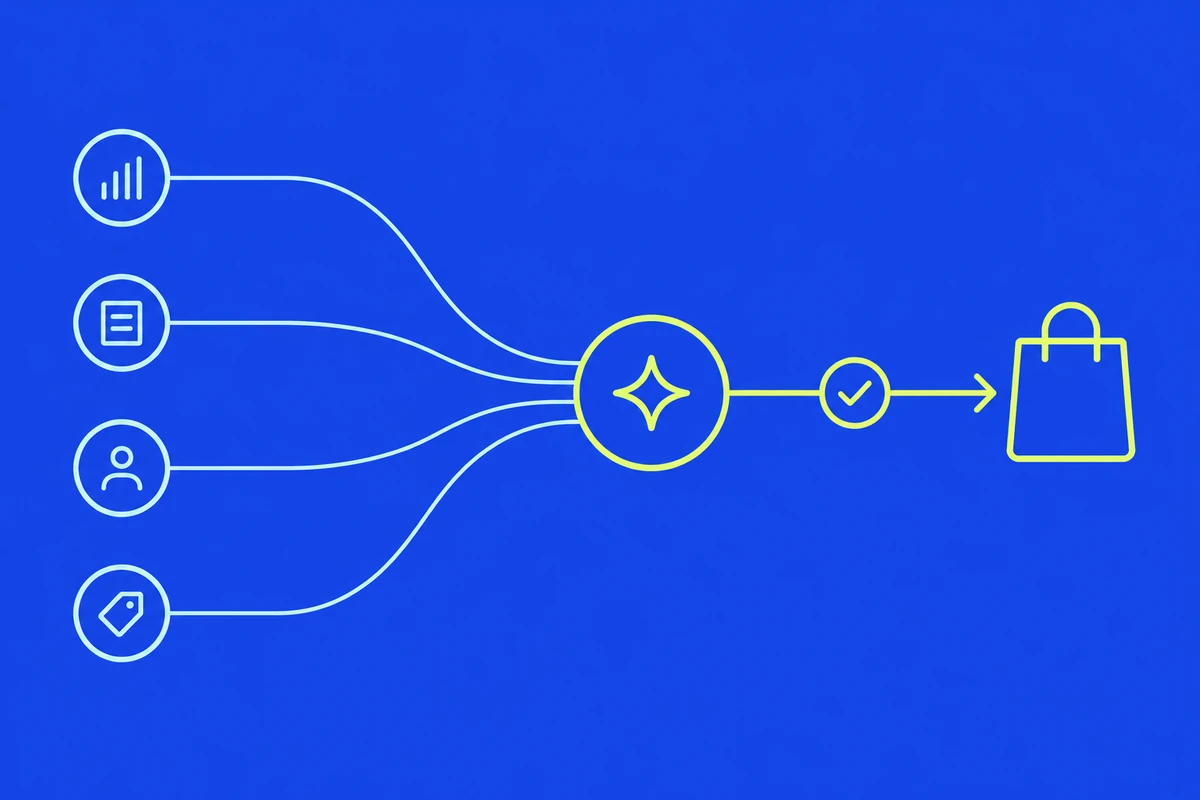
Agentic commerce is a new retail system in which users make demands and agents (not users) complete the following tasks: research, compare, negotiate, and transact.
Agentic Commerce comprises Autonomous AI Agents, a Commerce Graph, memory, and actions.
2.1 Autonomous AI Agents
These agents are able to:
- Interpret user intent with near-human fluency
- Scan through catalogs, specs, reviews, and warranties
- Determine the best matches with respect to given constraints
- Analyze prices, brands, and sellers
- Identify trade-offs
- Summarize the results
- Transact on user’s behalf
- Manage the post-purchase workflow
Agents do reasoning and analysis to find best solutions.
2.2 The Commerce Graph
The commerce graph represents all user decisions and preferences, including:
- Products
- Attributes
- Compatibility constraints
- Inventory
- SLAs
- Bundles and Offers
- Fulfillment paths
- Preferences
This is the substrate on which agents compute solutions.
2.3 Memory
Agents have:
- Session memory
- Long-term memory of users’ preferences
- Organization and household profiles
- Purchase history
- Maintenance and renewal cycles
- Ecosystem compatibility
Memory gives agents the ability to function as long-term user advocates.
2.4 Actions
Agents are doers; they are able to:
- Process and complete orders
- Initiate and manage returns
- Track and manage shipments
- Replenish and manage consumables
- Resubscribe and/or cancel
- Contact warranties and/or product support
- Negotiate on behalf of user
- Run analyses and comparisons
- Initiate insurance claims
- Trigger workflows in CRM/ERP
Act on behalf of the user.
3. Why Is This Happening Now?
4 things have come together to make agentic commerce possible:
3.1 Grounding + Retrieval + Tool Use
LLMs hallucinate. But with RAG and Actions, we have:
- Factual accuracy
- Full catalog grounding
- Real time inventory awareness
- Policy understanding
- Consistent reasoning paths
And (most importantly) we have shifted from predicting the next token to predicting the next correct action.
3.2 Standardized Agent Tooling (OpenAI, Amazon, Google, Stripe)
OpenAI's Commerce Toolset, Amazon's Rufus, Google's AI Mode and Gemini Agents products are some of the upcoming offerings that surface products with significant reasoning and are headed towards commerce. Etsy has integrated its seller network to the OpenAI effort (Instant Checkout in ChatGPT). There are also other open frameworks such as Mirix and Supermemory, that make agent orchestration and memory more reliable for folks building their own agents.
Agents now have:
- Tool use with assurance
- Reliable API calling
- Chain-of-thought suppression with reasoning traces
- And better safety and grounding
- Debuggable execution
Consumer-facing autonomy is now safe enough.
3.3 Enterprise Readiness
APIs, schemas, event architectures, and product data models in enterprises have matured.
For once, your backend can support intelligent workflows.
3.4 Emerging Protocols
The Model Context Protocol (MCP) is an open-source standard from Anthropic to connect AI applications with external systems. With MCP, AI applications like Claude or ChatGPT can connect with data sources, tools and workflows enabling them to perform tasks they were not previously able to do.
Agentic Commerce Protocol (ACP): Developed by Stripe and OpenAI, ACP gives merchants a way to interact with AI agents and enable instant checkout experiences.
Agent2Agent Protocol (A2A): The Linux Foundation's A2A Protocol, originally developed by Google, is a way for a variety of agents (built with different frameworks) to communicate and collaborate.
Agent Payments Protocol (AP2): Also developed by Google, AP2 is an open standard created with over 60 partners (such as Etsy, PayPal and Mastercard) to give agents the capability to initiate and complete payments. To authorize users and ensure responsibility for payments made by AI agents, the protocol utilizes "mandates" (digital contracts).
Different agents use the aforementioned protocols to fulfill different functions. A single agent may use the MCP to retrieve information and tools. Multiple agents may use the A2A to work on a common task. Lastly, if a financial transaction is required to be carried out, AP2 is used.
4. How Agentic Commerce Changes the Enterprise Operating Model
Most CXOs underestimate the impact of agentic commerce. This is because most CXOs believe agentic commerce is tied more closely to the user experience (UX) layer.
This is a misconception.
Agentic commerce impacts the enterprise across 6 layers:
Layer 1: Search & Discovery → Intent Understanding & Delegation
Users stop searching. They start instructing.
- "Find me a TV that can be used in a bright room and costs less than 40,000 INR."
- "Find me a protein supplement that is compatible with my lactose intolerance."
- "Renew my home insurance and find the best coverage to premium ratio."
Agents interpret and break down these instructions into multi-step evaluations.
For CXOs, this means:
- SEO is being absorbed into AEO (Agentic Experience Optimization).
- Your product data becomes your acquisition surface.
Layer 2: Product Pages → Configurable Knowledge Objects
Product detail pages no longer exist.
Agents no longer interpret webpages. They interrogate structured objects.
- specs
- compatibility matrices
- safety ratings
- historical reviews
- use cases
- expert knowledge
- maintenance and service cycles
- total cost of ownership
You have to break down your product offerings to constituent elements for LLMs.
For example, learn how to structure your product feed so ChatGPT can accurately index and display your products with up-to-date price and availability. It also covers how to handle product variants.
Layer 3: Personalization → Preference Memory
Old personalization uses:
- segmentation
- browsing history
- collaborative filtering
Agents use:
- dietary restrictions
- durability requirements
- ergonomic preferences
- financial constraints
- mission-level goals (e.g., “train for marathon”)
- brand trust models
This is not personalization. It is personal advocacy.
Layer 4: Sales → Autonomous Negotiation & Evaluation
Electricity plans? Loan products? Home appliances? SaaS subscriptions?
Agents evaluate:
- offers
- trade-offs
- hidden terms
- warranties
- reputational data
- risk
- long-term cost models
They can negotiate for the user:
“Find me the best appliance warranty provider and negotiate a lower deductible.”
Your sales operations must prepare for machine-to-machine negotiation.
Layer 5: Supply Chain → Autonomous Post-Purchase Management
Agents can handle:
- order tracking
- delay prediction
- preemptive rerouting
- optimize bundled shipments
- schedule maintenance
- automate replenishment
The supply chain becomes agent-orchestrated. Humans in the loop may continue to be the operative model for most enterprises for some time; however, it is unlikely to be the case in the distant future. GRC teams are actively working to overcome bottlenecks and barriers to a fully agentic future.
Layer 6: Customer Support → Autonomous Service Agents
Returns, replacements and warranties become:
- understood automatically
- policy checked
- triaged
- resolved
Costs of support decrease.
Customer satisfaction increases.
Friction decreases.
5. The Agentic Commerce Stack (A CXO’s Architecture Map)
The 7 layers of a complete agentic commerce platform are as follows:
5.1 Knowledge Layer
- Domain-specific product knowledge
- Policy libraries
- Warranty rules
- Compatibility graphs
- LLM-normalized catalog schema
This is your single source of truth.
5.2 Retrieval Layer
It uses hybrid BM25 + vector recall, exactly like Fractics NOVA. Additionally, it supports tool-aware retrieval and context re-ranking.
Citation-first responses are also provided.
5.3 Reasoning Layer
It includes a modular version of chain of thought as well as verifiable reasoning. Other features include guardrails, safety, and preference memory.
5.4 Action Layer
It supports API calling and cart manipulation. Furthermore, it supports payment processing and order management. Additionally, it supports CRM and ERP actions.
5.5 Memory Layer
It includes short-term and long-term memories. Household profiles are also supported. Mission planning is also included.
5.6 Personal Agent Layer (User-Facing)
It includes shopping, finance, warranty, subscriptions, and negotiation agents.
5.7 Merchant Agent Layer (Enterprise-Facing)
It includes catalog optimization, price elasticity, and merchandising agents. Additionally, it includes inventory and fulfillment agents.
The ecosystem becomes multi-agent commerce.
If you need a context-aware, agentic chat-to-commerce solution, we’d love to show you a demo of NOVA, our context-aware conversational agent.
6. Business Impact: What CXOs Need to Track
Agentic commerce changes your business model and economic forces.
What you measure changes:
6.1 Website Traffic → Agentic Presence
Instead of battling for traffic, you battle for agentic presence.
To win, you must optimize for:
- APIs
- Ontologies
- Structured Data
- Product Grounding
This is the new SEO.
6.2 Conversion Rate → Decision Success Rate
Conversions become a byproduct of agentic success.
New KPIs become:
- Did the agent understand the catalog correctly?
- Did the agent compute the trade-off correctly?
- Does the agent trust your data?
- Did it find your product optimal for the user’s goals?
Your new KPI: Decision Fit Score (how well your product matches agent-evaluated constraints).
6.3 Customer Acquisition Costs → Agent-Oriented Acquisition
Paid acquisition becomes much less relevant.
Agents filter:
- Bad products
- Untrustworthy sellers
- Poor pricing
- Poor specifications
CAC decreases when your data quality is right.
6.4 AOV → Outcome-Based Bundling
Agents can bundle:
- Accessories
- Warranties
- Consumables
- Extended life cycle products
Average Order Value (AOV) increases.
6.5 Retention → Autonomous Lifecycle Management
Agents can manage:
- Filter replacements
- Replenishment cycles
- Subscription optimization
- Upgrades
Retention becomes continuous.
7. CXO Imperatives: What You Must Do Now
If you're leading a retail, financial, telecom, logistics, insurance, travel, or SaaS business, here's what you should be focusing on now.
7.1 Build Your Commerce Knowledge Vault
Drop your PDFs, unstructured PDPs, and marketing copy.
You need ontologies, schema, and product graphs to build your knowledge vault.
Product specs and pricing, as well as warranty and rule sheets, and contracts, should also be included. Your Knowledge Vault becomes your storefront.
At Fractics, we partner with organizations to build their first AI advantage in 30 days.
7.2 Rebuild Your APIs for Machine Users
Agents require:
- Stable schemas
- Clear contracts
- Composable APIs
- Action endpoints
APIs become your distribution channel.
7.3 Teach Agents Domain Logic
This includes:
- Warranty and return policies
- Financial and serviceability constraints
- Logistics and fulfillment networks
Agents must internalize your differentiators.
7.4 Build a Fleet of Merchant Agents
Examples include:
- Catalog Intelligence Agent: auto-fixes spec errors
- Inventory Agent: predicts reorder cycles
- Pricing Intelligence Agent: optimizes elasticity
- Fulfillment Agent: optimizes routing
- Service Agent: resolves support events
These reduce operating costs significantly.
7.5 Prepare For Agent-vs-Agent Competition
Consumers will deploy personal agents. Merchants will deploy sales agents. They will negotiate.
Your systems must be prepared to address:
- machine arbitration
- transparent pricing
- preference-based bidding
- multi-objective optimization
This will shape the future of the digital economy.
8. What the Future Looks Like (2025-2030)
2025
First-generation agents are used in the enterprise for support, shopping, and catalog assistance.
2026
About 30-40% of product discovery is agent-mediated. Ecosystem-wide shift from SEO to AEO.
2027
Emergence of multi-agent ecosystems. Decision quality is the primary KPI.
2028
Products can be AI-navigated. Every SKU has specs, compatibility, context, lifecycle, and intent graph.
2029
Commerce logs are predominantly machine-first, not human-first.
2030
The majority of online transactions are started by agents, not people. Your “customer” is half-agent, half-human.
Your “competitor” is the one with the better-trained agents.
9. Final Word: From Websites to Autonomous Value Networks
Commerce has been about reducing friction.
We started with physical browsing and created e-commerce.
We reduced friction with search. We reduced friction with recommendations. We reduced friction with wallets. We reduced friction with apps to complete tasks.
What is left to reduce?
What if we were to reduce friction for thinking and acting?
Agentic commerce is more than a stack of commerce technologies. It is a new contract between commerce and cognition.
The companies of the future will design products and services where:
- knowledge is agent-readable
- logic is agent-trainable
- APIs are agent-accessible
- products are agent-preferred
- workflows are agent-orchestratable
What does that really mean?
The companies of the future will build for machines as seriously as they build for humans.
And that is the real transformation CXOs must lead.
Sources and references
Agent2Agent Project. (n.d.). Agent2Agent (A2A) protocol. Retrieved October 10, 2026, from https://a2a-protocol.org/latest/
Google. (n.d.). Agent Payments Protocol (AP2). Retrieved October 10, 2026, from https://ap2-protocol.org/
Model Context Protocol. (n.d.). What is the Model Context Protocol (MCP)? Retrieved October 10, 2026, from https://modelcontextprotocol.io/docs/getting-started/intro
OpenAI, & Stripe. (n.d.). Agentic Commerce Protocol. Retrieved October 10, 2026, from https://www.agenticcommerce.dev/